
Cheek decoration
Create reflective accents on the outer cheek with a formulation and placement assessed for the intended use. Keep eye-area and lip products as separate development briefs.
FACE & BODY
Cheek accents, festival body glitter and adhesive decorative shapes. Specify the complete skin-contact system before selecting a finish.
Discuss this application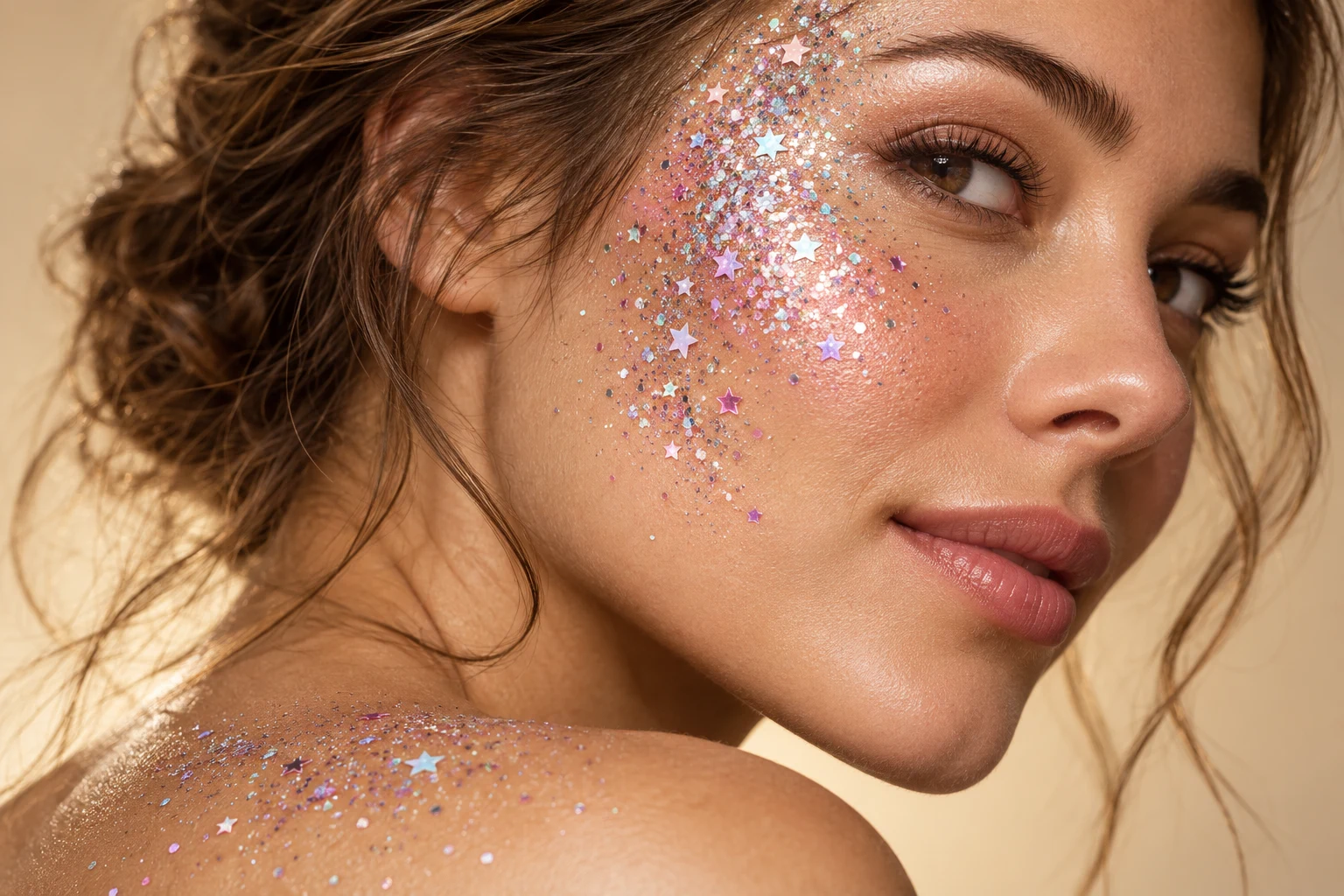
THE PROJECT AT A GLANCE
WHERE THE FINISH WORKS
Create reflective accents on the outer cheek with a formulation and placement assessed for the intended use. Keep eye-area and lip products as separate development briefs.
Specify adhesion on the intended body area, resistance to wear, particle shedding and comfortable removal.
Assess the complete decorative piece, backing and adhesive. Confirm product classification and skin compatibility rather than transferring evidence from loose glitter.
YOUR DEVELOPMENT CHECKLIST
Use these six points to prepare the sample brief. Set the test method and pass criteria for your finished product before approving a material.
| Requirement | What to specify | What to verify |
|---|---|---|
| Placement & wear | Cheek or body placement, wear duration, removal method and user age group. | Evaluate the defined use; do not extend cheek/body evidence to eyelids, lips or mucous membranes. |
| Particle & coating | Exact substrate, colourant, coating, shape, cut and size distribution. | Assess edges, loose-particle shedding, migration and material identity in the safety review. |
| Adhesive system | Ready-to-stick decoration, adhesive gel or loose glitter applied with a separate skin adhesive. | Evaluate the final combination, adhesion during wear, removal and adhesive residue; glitter alone is not self-adhesive. |
| Skin compatibility | Finished formulation, dose, contact duration and intended population. | Assessor-defined irritation and sensitisation programme, with a report tied to the exact sample. |
| Stability & hygiene | Shelf life, storage, packaging and preservation where relevant. | Stability, microbiological quality and preservation efficacy as appropriate to the format. |
| Market & material | Destination market, product classification and polymer/coating identity. | Check applicable cosmetic rules and EU REACH microplastics restrictions for the exact format; a biodegradable label alone is insufficient. |
CONNECT THE SAMPLE TO ITS RECORDS
Request the following for the selected grade and project. The available documents below show their own sample identity and scope.
Documentation for this selection
Documentation must be confirmed for your selected material, coating and colour. Request the current composition, technical data and relevant test evidence before making an environmental or application claim.
Request grade-specific documentsFROM PROCESS TO PARTICLE
Choose loose glitter, a formulated gel or an adhesive decorative article.
Link the exact material, adhesive and batch to the required safety records.
Complete the relevant testing, assessment and market documentation before production release.
PHYSICAL MATERIAL REFERENCES
No grade is pre-approved for this skin-contact brief. Request exact composition and finished-system evidence before selecting a material.
Choose a colour referenceON YOUR SAMPLE BENCH
APPLICATION QUESTIONS
Loose glitter is not self-adhesive. A ready-to-stick decoration includes an adhesive layer; other formats use a suitable cosmetic gel or adhesive. The complete system needs assessment for the intended use.
No single certificate covers all materials, adhesives, application areas and markets. Review composition, appropriate testing and the finished-product compliance file. Management-system certificates do not demonstrate skin safety.
Do not infer eye-area suitability from face or body use. Assess the exact material, colour additives, placement and applicable restrictions separately.
REGULATORY REFERENCES
Requirements depend on product classification and the exact intended use. References reviewed October 2026.
YOUR APPLICATION. YOUR REFERENCE.
Tell us the placement, wear time, adhesive format, age group and destination market. Skin-contact suitability must be reviewed for the exact finished product.
Enquire with this application brief