Specify the finish around your paper, board, adhesive and converting process. Compare the sparkle on a printed sample, then check how the decoration handles drying, folding and transport.
Gift packaging — sparkle on the finished box and decorative wrap.Kaboompics / Pexels
THE PROJECT AT A GLANCE
Finished products
Gift boxes, sleeves, greeting cards and decorative labels
Working surface
The actual paper or board, print, adhesive and finishing layers
Approval reference
A converted pack or printed panel, plus an identified material retain
WHERE THE FINISH WORKS
Define the finished product.
Printed paper and board
For a decorative area on a carton, card or sleeve, identify the exact substrate and printed background. Review the sample against the artwork so the chosen particle does not obscure fine detail or extend beyond the intended adhesive area.
Labels and stationery finishes
Develop the effect at its final viewing size. A close-up of loose glitter cannot establish the appearance of a small label, and a hand-applied sample does not establish performance on a coating or printing line.
Packs that will be folded or assembled
Include scoring, folding, cutting and packing in the trial. Agree how much texture is acceptable and where the decorated surface may contact adjacent sheets or finished products.
YOUR DEVELOPMENT CHECKLIST
Specify the process. Agree the acceptance checks.
Use these six points to prepare the sample brief. Set the test method and pass criteria for your finished product before approving a material.
Requirement
What to specify
What to verify
Substrate & artwork
Paper or board grade, coating, printed background, decorated area and smallest artwork detail.
Make the trial on the production substrate. Compare colour, coverage and edge definition with the agreed design.
Particle size & equipment
Selected cut and shape with units; screen opening, nozzle or coating-gap limits.
Run the intended delivery path. Agree acceptable detail, texture and any equipment interruptions before selecting the cut.
Adhesive & application
Adhesive or ink system, mixed-in or surface-applied route, loading and application sequence.
Check adhesion and particle release after drying using the agreed method. For plant-fiber material, review the selected-grade handling guidance first.
Drying & curing
The complete time/temperature schedule, repeated passes, topcoat and lamination steps.
Evaluate the finish after the full production sequence. Agree acceptable changes in colour, surface and particle retention.
Converting & handling
Scoring, folding, die cutting, stacking orientation and expected handling.
Inspect crease lines, cut edges, rub-off and transfer to adjacent sheets or packs. Set the acceptance limits together.
End use & market
Destination market, intended package use and whether any food-contact assessment is relevant.
Have the responsible packaging team approve the finished construction and required evidence; a glitter sample alone is not that assessment.
CONNECT THE SAMPLE TO ITS RECORDS
Build the material review file.
Request the following for the selected grade and project. The available documents below show their own sample identity and scope.
01Selected-grade specification
Match the sample code, substrate, finish, cut dimensions and size units to the quotation and retained material.
02Material and handling information
Request the current SDS and technical instructions for the exact grade. Review water/solvent exposure and the intended adhesive route.
03Relevant substance reports
Identify the requested substances, methods, limits and destination-market needs. Confirm that the report sample matches the chosen construction and colour.
04Finished-pack trial record
Keep the substrate, adhesive, loading, cure and converting conditions with the approved panel and acceptance criteria.
Available documentation
Available documents for material review
Open the supplied originals and compare the tested sample with your specification. These records apply to the samples and methods identified in each document.
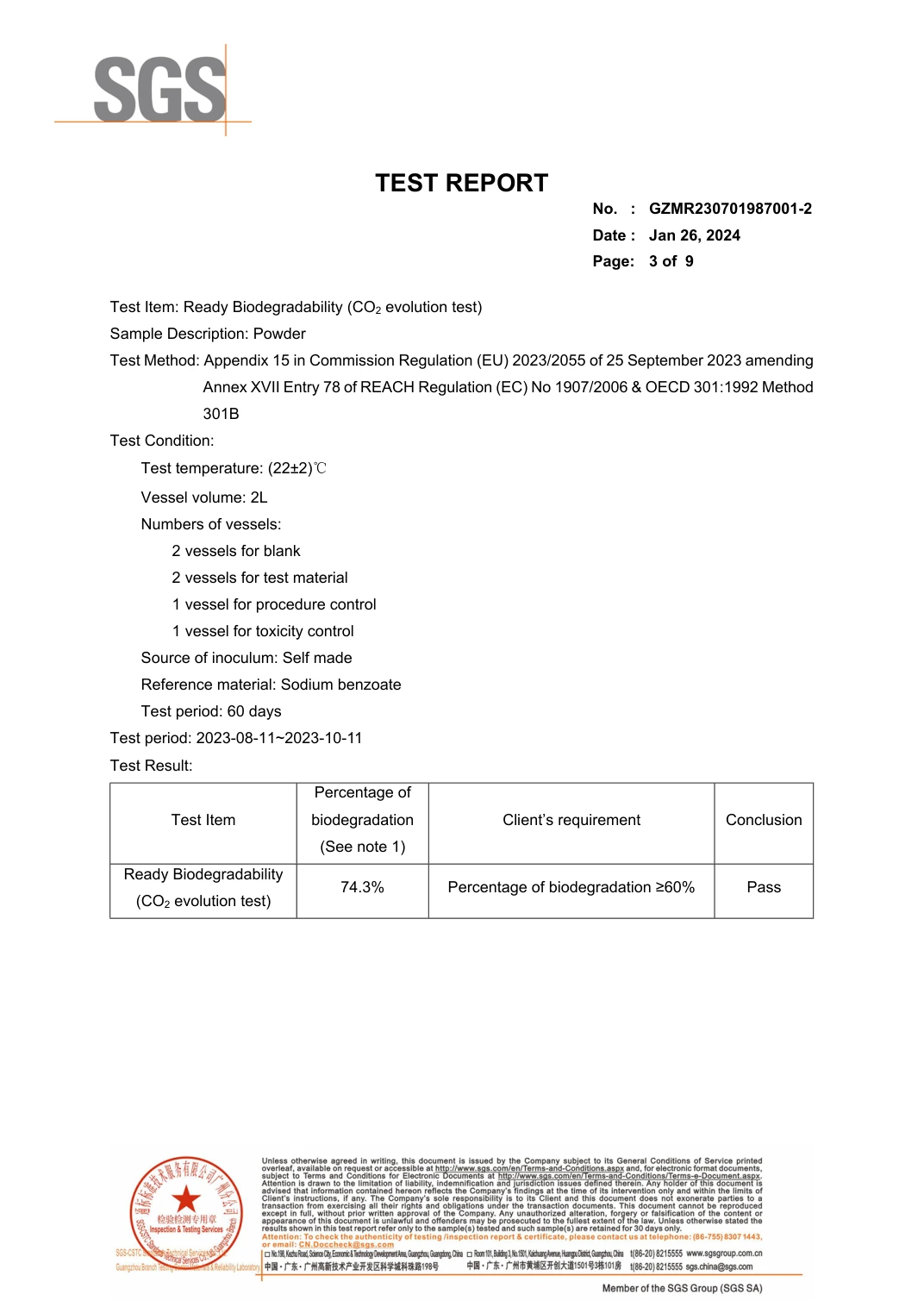
Sample scope. The sample photograph identifies plant-fiber degradable glitter, specification 1/96. Match the purchased grade to this report.
Recorded result. 74.3% biodegradation after 60 days at 22 ± 2°C. The report records Pass against the client requirement of at least 60%.
Method. OECD 301:1992, Method 301B — CO₂ evolution test; The report also cites Appendix 15 of Commission Regulation (EU) 2023/2055
This result belongs to the tested sample and stated laboratory conditions. It does not establish marine or home-compost performance, or a blanket regulatory exemption.
Dated sample report; no expiry date is stated. Confirm the selected grade and the current requirements before ordering.
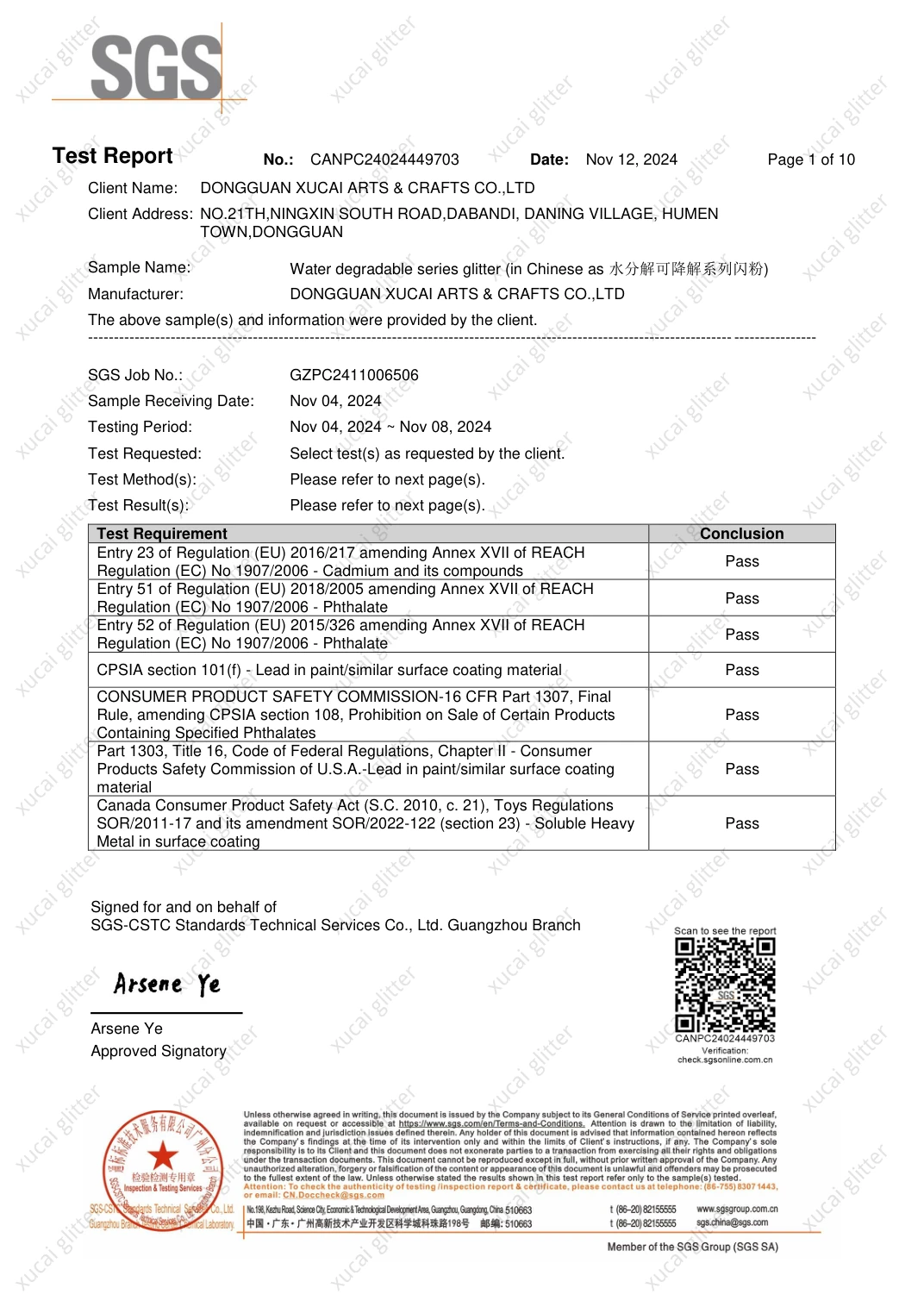
Recorded result. The listed cadmium, restricted-phthalate, lead and element-migration requirements are marked Pass. Additional phthalate measurements are listed as See Results.
Method. REACH Annex XVII: selected cadmium and phthalate requirements; EN 71-3:2019+A1:2021: migration of certain elements; CPSIA / 16 CFR: selected lead and phthalate requirements; ISO 8124-3:2020/Amd.1:2023: migration of certain elements; ASTM F963-23: selected surface-coating requirements
Selected material tests do not certify the finished packaging, toy or cosmetic. Review the exact test scope, colour and grade against the intended use.
Dated sample report; no expiry date is stated. Confirm the selected grade and the current requirements before ordering.
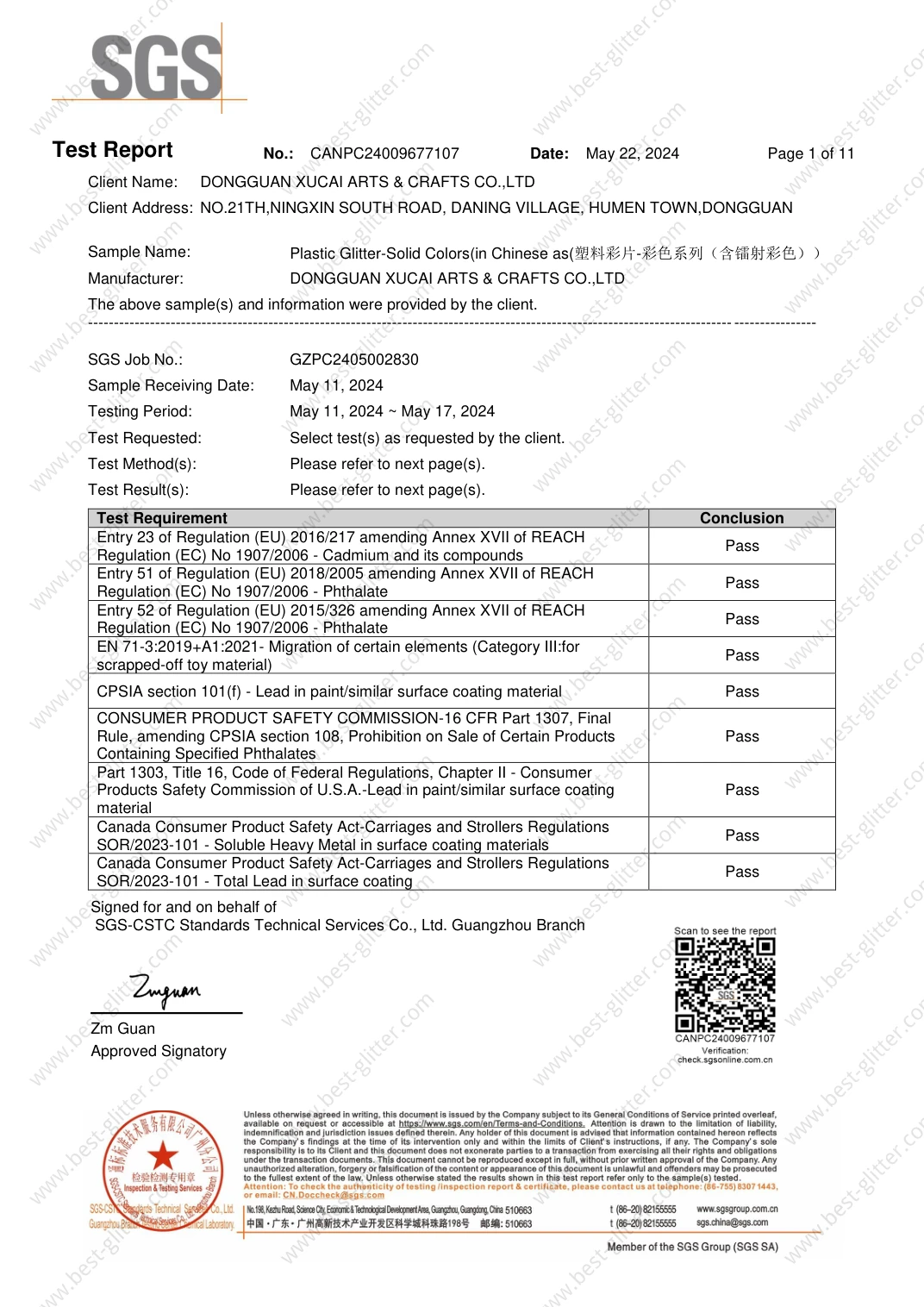
Plastic Glitter–Solid Colors, including laser colours
Scope & limitations +
Sample scope. Reference report for this colour series; confirm the current ordered grade, colour and particle size with XUCAI.
Recorded result. The listed cadmium, restricted-phthalate, lead and element-migration requirements are marked Pass. Bisphenol A and additional phthalates are reported as See Results.
Method. REACH Annex XVII: selected cadmium and phthalate requirements; EN 71-3:2019+A1:2021: migration of certain elements; CPSIA / 16 CFR: selected lead and phthalate requirements; ISO 8124-3:2020/Amd.1:2023: migration of certain elements; ASTM F963-23: selected surface-coating requirements
Applies to the submitted sample and listed tests. This is not a full REACH, toy-safety or cosmetic certification and does not cover every colour, batch or finished formulation.
Dated sample report; no expiry date is stated. Confirm the selected grade and the current requirements before ordering.
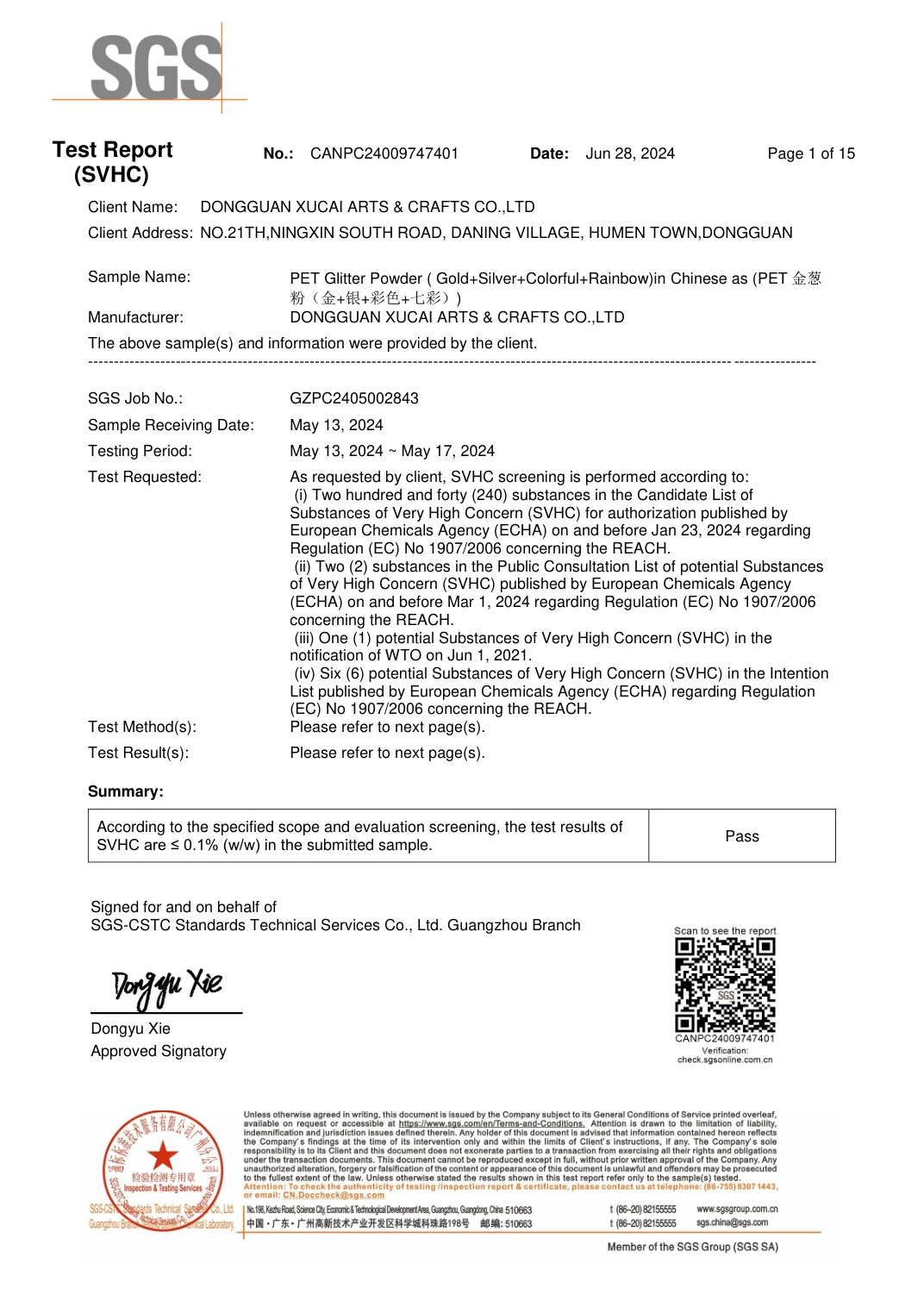
PET Glitter Powder (Gold + Silver + Colorful + Rainbow)
Scope & limitations +
Sample scope. Gold, silver, coloured and rainbow PET glitter in the submitted sample. Review the full report and request updated screening where the current market or product requires it.
Recorded result. The report records Pass, with screened SVHC at or below 0.1% by weight in the submitted sample.
Method. 240 ECHA Candidate List substances published on or before 23 January 2024; Additional consultation / intention substances expressly listed in the report
The substance list is dated and may have changed. This is not proof of compliance with the current entire REACH regulation or approval for cosmetic, food-contact or other finished-product uses.
Dated sample report; no expiry date is stated. Confirm the selected grade and the current requirements before ordering.
A test report records a result for a submitted sample. An SDS or MSDS provides safety information. Neither should be presented as a certification of every colour, series or finished product.
FROM PROCESS TO PARTICLE
A practical selection path.
01
Define the substrate and artwork
Send the paper or board specification, printed base colour and location of the decorative area. Include a reference pack or a physical colour target when available.
02
Match the cut to the application equipment
Ask the printing team to review particle dimensions against the screen opening, dispensing equipment or coating gap. Confirm the size convention and proposed cut before treating two samples as equivalent.
03
Prepare a production-relevant panel
Use the intended adhesive or ink, loading and drying schedule. Compare both the appearance and edge definition, including any topcoat or laminate that is part of the final construction.
04
Approve the converted sample
Keep an agreed finished panel and a loose-material retain. Record the material code, application conditions and acceptance checks before confirming the order specification.
PHYSICAL MATERIAL REFERENCES
Material samples to trial.
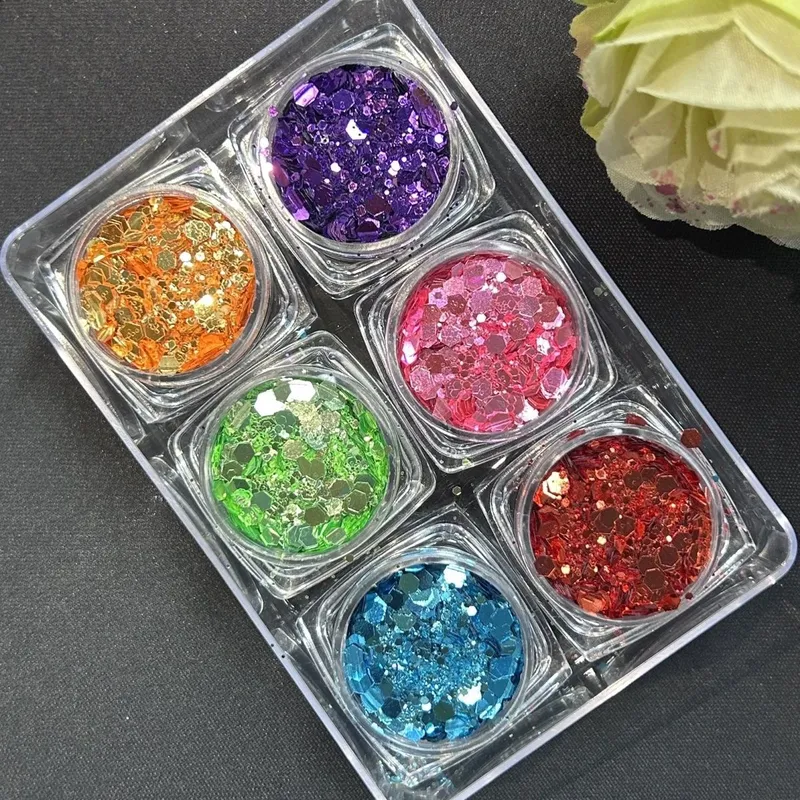
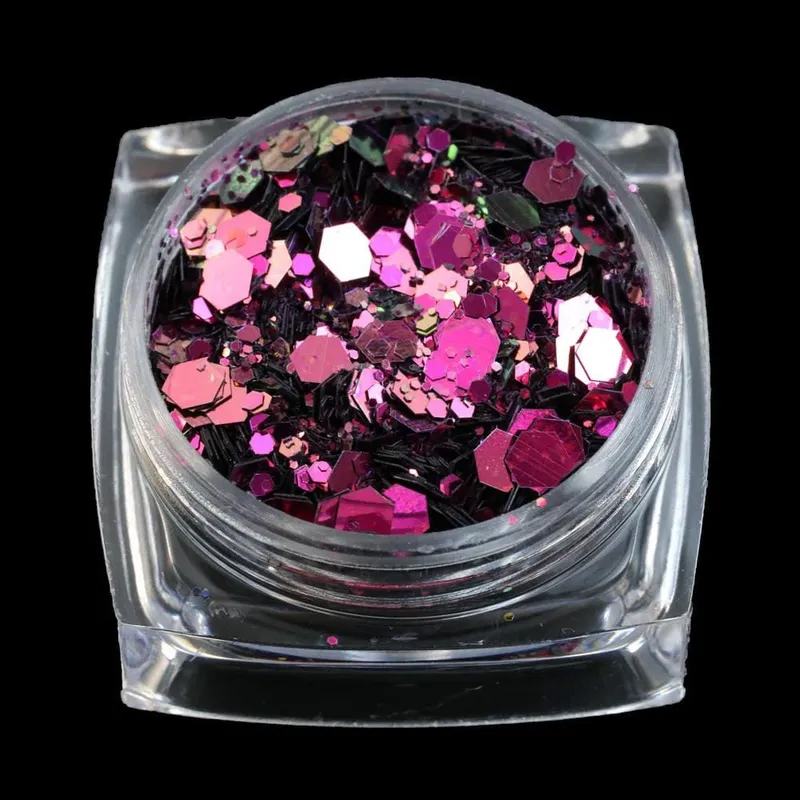
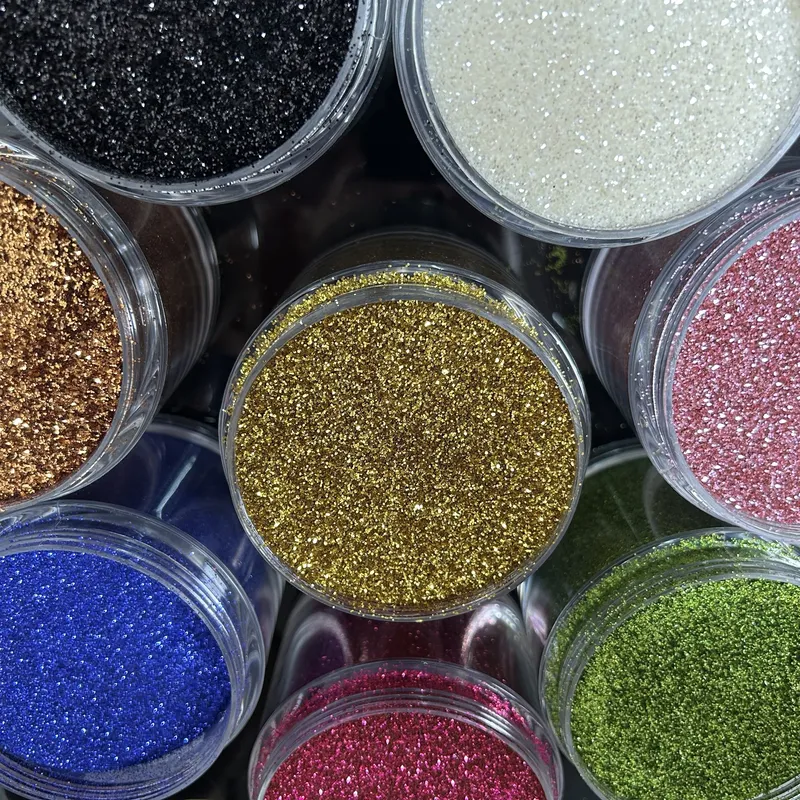
Compare these material candidates after reviewing your process and document needs. The photographs below show glitter samples for product selection.
Can I select a particle size from the colour card alone?+
Use the card to identify candidates, then confirm the dimensions and test the cut with your printing equipment. Do not assign units to an unlabelled fraction on a card; ask for the specification of the selected grade.
Can plant-fiber glitter be mixed into our printing ink?+
Do not assume that route is suitable. The existing supplier handling guidance for the water-degradable range does not recommend premixing into oil or adhesive for later printing or coating. Share the exact process and request current instructions for the selected material.
Does a packaging application imply food-contact suitability?+
No. State the intended pack use and contact conditions in the enquiry. Ask the responsible assessor which material and finished-pack evidence is required; a decorative sample does not establish that conclusion.
Industry requirements
Make the brief specific.
Explore what matters in your sector, which documents to request and what to agree before approving a sample.
Tell us the paper or board, printed background, adhesive or ink, application equipment, drying conditions and converting steps. Add the target effect, particle reference, destination market, order quantity and packing needs. Mention any contact-related requirements for the finished pack.