Build a coherent craft collection around how the glitter will be applied, handled and packed. Review colour, shape, coverage and the intended users before choosing a sample assortment.
Seasonal decoration — glitter-coated ornaments in use.XUCAI source website
THE PROJECT AT A GLANCE
Finished products
Craft kits, stationery, seasonal decorations and refill assortments
Working surface
The craft base and adhesive, or a defined loose-material activity
Approval reference
A finished craft sample and packed assortment with agreed colours and cuts
WHERE THE FINISH WORKS
Define the finished product.
Loose craft material assortments
Define the intended users, application instructions and destination market. Choose colours that form a useful range and decide whether each pack contains one cut or an agreed blend. Loose-material use needs its own product and market review.
Cards and decorated stationery
Test the selected sample on the actual glue and surface. Compare coverage, detail and the amount of loose material remaining after the piece has dried and been handled.
Decorative shapes and themed mixes
Use a physical blend reference to agree the balance of colours, outlines and sizes. Review the mixture after filling and normal handling so the pack presents the intended combination.
YOUR DEVELOPMENT CHECKLIST
Specify the process. Agree the acceptance checks.
Use these six points to prepare the sample brief. Set the test method and pass criteria for your finished product before approving a material.
Requirement
What to specify
What to verify
Activity & intended users
The actual craft activity, age group, use instructions, destination market and loose or bonded material format.
Have the responsible product team review the finished kit or item. Do not treat a craft-grade description as an age or safety approval.
Colours, shapes & blend
An identified colour reference, particle dimensions and shape list; blend components and intended proportions.
Approve a physical blend and packed reference. Check the assortment after filling and handling, not only in a close-up photograph.
Adhesive & base
Paper, card, fabric or another base; glue identity, application route and drying conditions.
Compare coverage, colour and particle retention after the glue dries on the actual base.
Handling & dispensing
How the user pours, sprinkles or applies the product and the expected cleanup or particle-release behaviour.
Trial the actual container and activity. Record flow, bridging, unwanted release and any instructions needed for the chosen use.
Packaging & labels
Fill weight, container opening, closure, label, outer pack and any required filling tolerance.
Approve a filled pack for dispensing and closure performance. Confirm the agreed pack specification with the order.
Environmental wording
The exact intended claim, complete particle construction and relevant end-of-life conditions.
Link each claim to the correct material and evidence. A PLA or plant-fiber name alone does not establish every environmental outcome.
CONNECT THE SAMPLE TO ITS RECORDS
Build the material review file.
Request the following for the selected grade and project. The available documents below show their own sample identity and scope.
01Assortment and material specification
Record every colour, cut, shape and material code in the approved blend or kit; keep the packed reference.
02Selected-grade safety information
Request the current SDS and relevant composition or test information for the intended project and market.
03Finished-product assessment
If the project has age-related, toy or other regulated requirements, identify the assessment and evidence needed for the actual finished item.
04Claim-specific environmental evidence
For an environmental statement, check the complete product, test conditions, outcome and any remaining information before choosing public wording.
Available documentation
Available documents for material review
Open the supplied originals and compare the tested sample with your specification. These records apply to the samples and methods identified in each document.
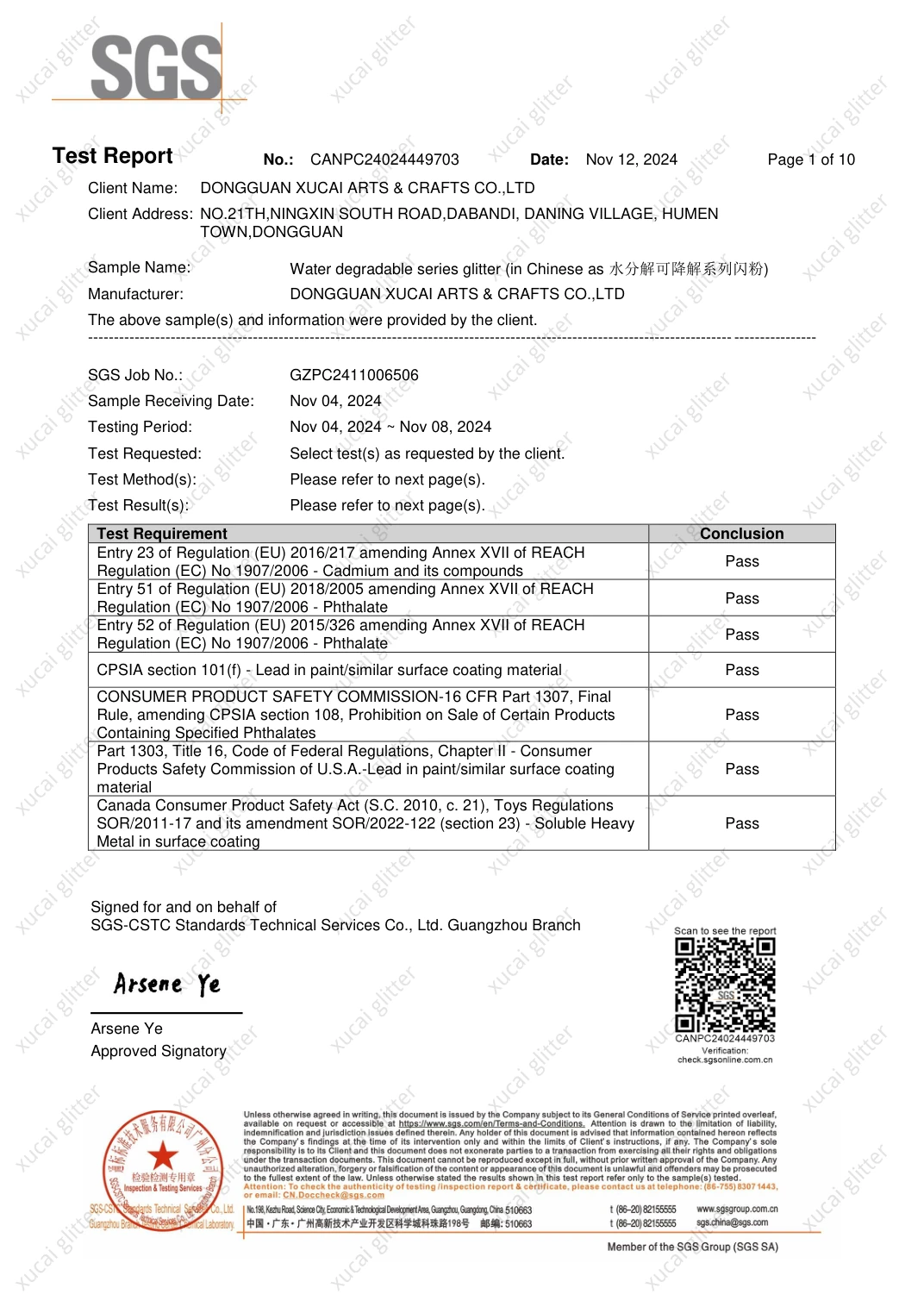
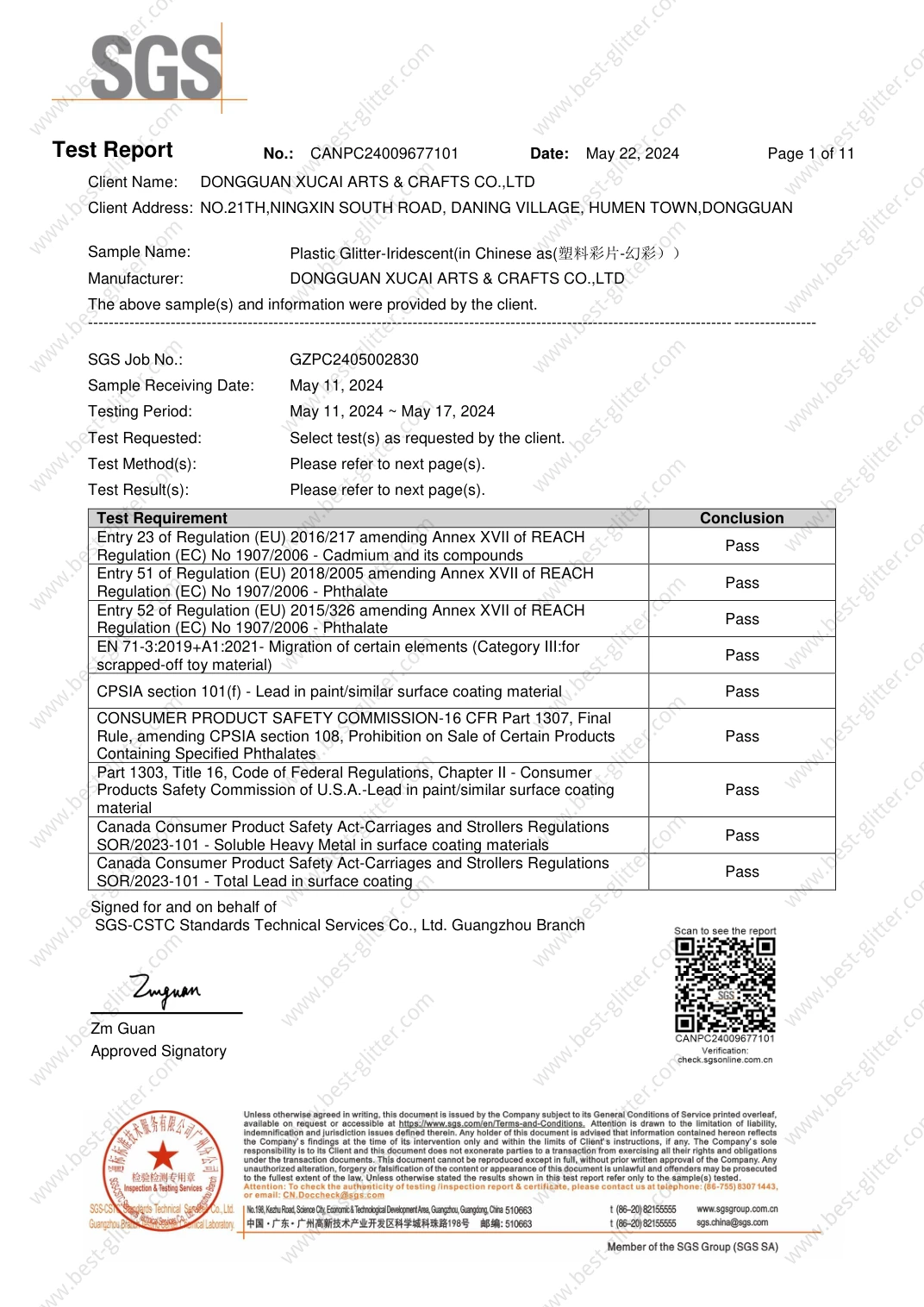
Recorded result. The listed cadmium, restricted-phthalate, lead and element-migration requirements are marked Pass. Additional phthalate measurements are listed as See Results.
Method. REACH Annex XVII: selected cadmium and phthalate requirements; EN 71-3:2019+A1:2021: migration of certain elements; CPSIA / 16 CFR: selected lead and phthalate requirements; ISO 8124-3:2020/Amd.1:2023: migration of certain elements; ASTM F963-23: selected surface-coating requirements
Selected material tests do not certify the finished packaging, toy or cosmetic. Review the exact test scope, colour and grade against the intended use.
Dated sample report; no expiry date is stated. Confirm the selected grade and the current requirements before ordering.
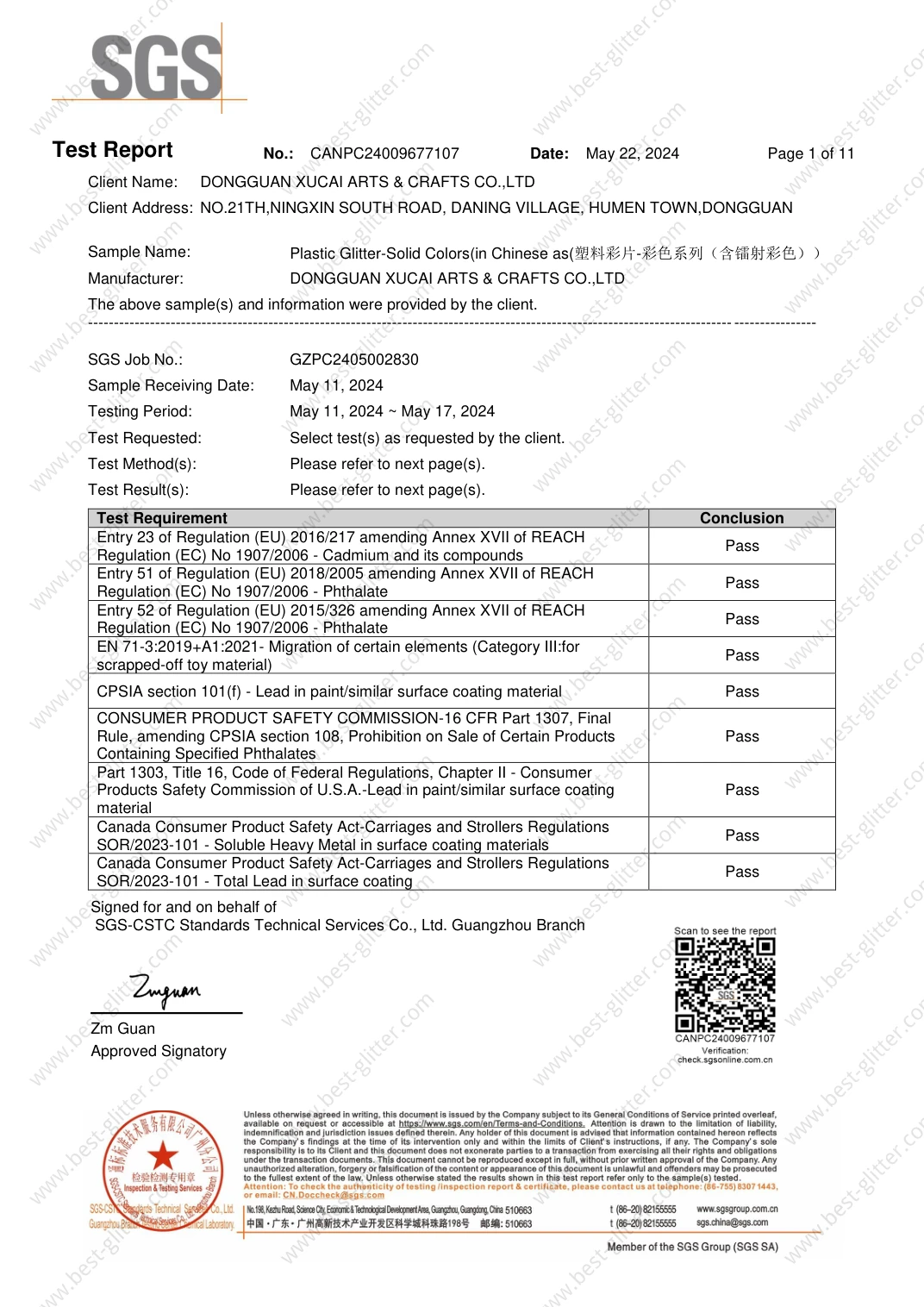
Plastic Glitter–Solid Colors, including laser colours
Scope & limitations +
Sample scope. Reference report for this colour series; confirm the current ordered grade, colour and particle size with XUCAI.
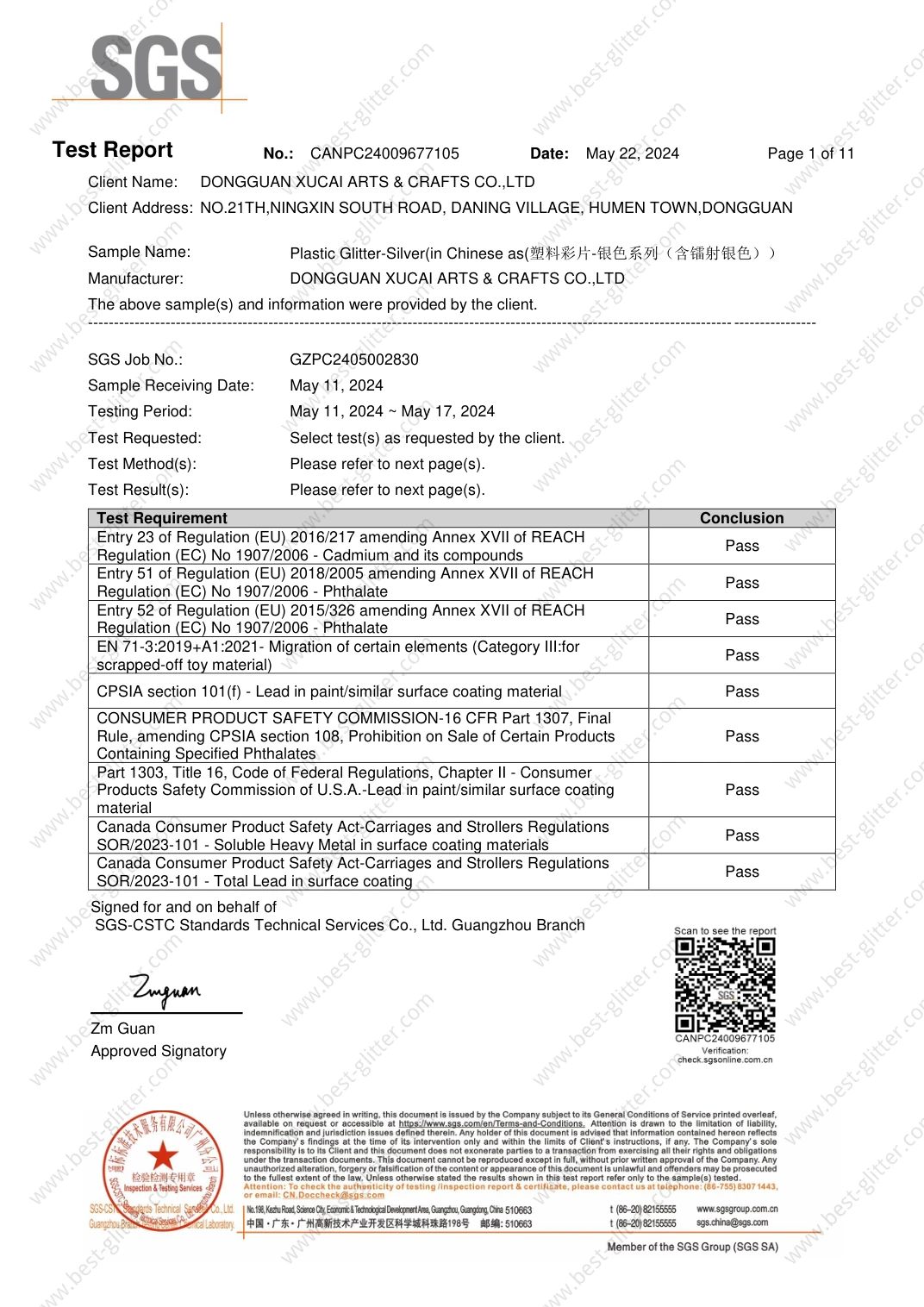
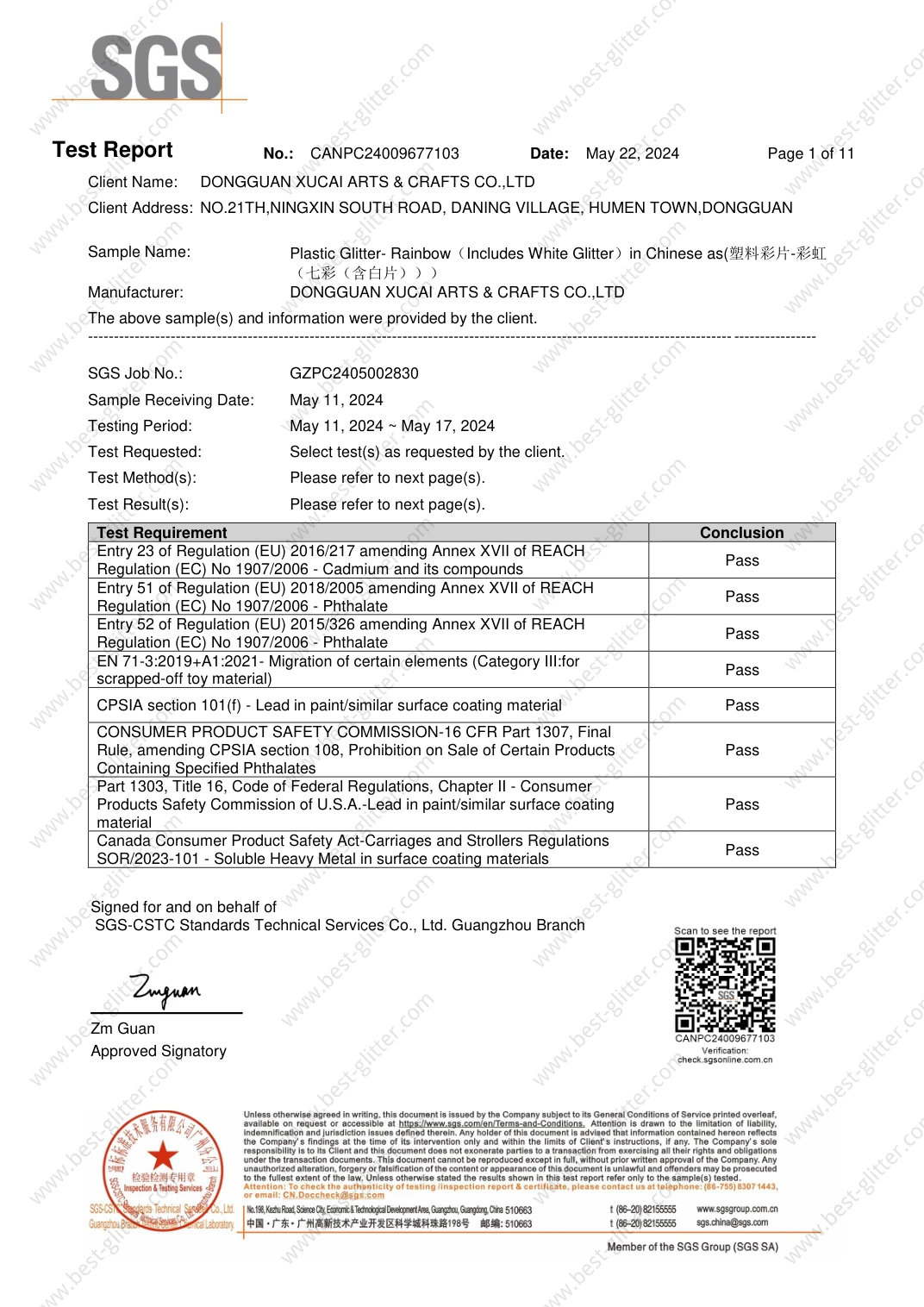
Recorded result. The listed cadmium, restricted-phthalate, lead and element-migration requirements are marked Pass. Bisphenol A and additional phthalates are reported as See Results.
Method. REACH Annex XVII: selected cadmium and phthalate requirements; EN 71-3:2019+A1:2021: migration of certain elements; CPSIA / 16 CFR: selected lead and phthalate requirements; ISO 8124-3:2020/Amd.1:2023: migration of certain elements; ASTM F963-23: selected surface-coating requirements
Applies to the submitted sample and listed tests. This is not a full REACH, toy-safety or cosmetic certification and does not cover every colour, batch or finished formulation.
Dated sample report; no expiry date is stated. Confirm the selected grade and the current requirements before ordering.
A test report records a result for a submitted sample. An SDS or MSDS provides safety information. Neither should be presented as a certification of every colour, series or finished product.
Craft decoration — glitter, adhesive and finished-object detail.XUCAI source website
FROM PROCESS TO PARTICLE
A practical selection path.
01
Identify the user and the activity
Describe what the customer will make, how glitter is applied and whether the range is intended for children or adults. Do not use a decorative appearance or a material name as a safety conclusion.
02
Assemble a purposeful colour range
Shortlist a small group of colours and effects using physical samples. Compare them on the craft base and identify whether a fine finish, visible shapes or a mixed texture serves the activity.
03
Trial the actual pack and closure
Ask about the requested fill weight, jar or bag format, label and dispensing method. Check the physical package, including leakage, closure and whether users can dispense the material as intended.
04
Retain the range reference
Record the accepted material codes, blend references and packing details. Keep a reference from each selected colour so a repeat order can be compared against the same collection.
PHYSICAL MATERIAL REFERENCES
Material samples to trial.
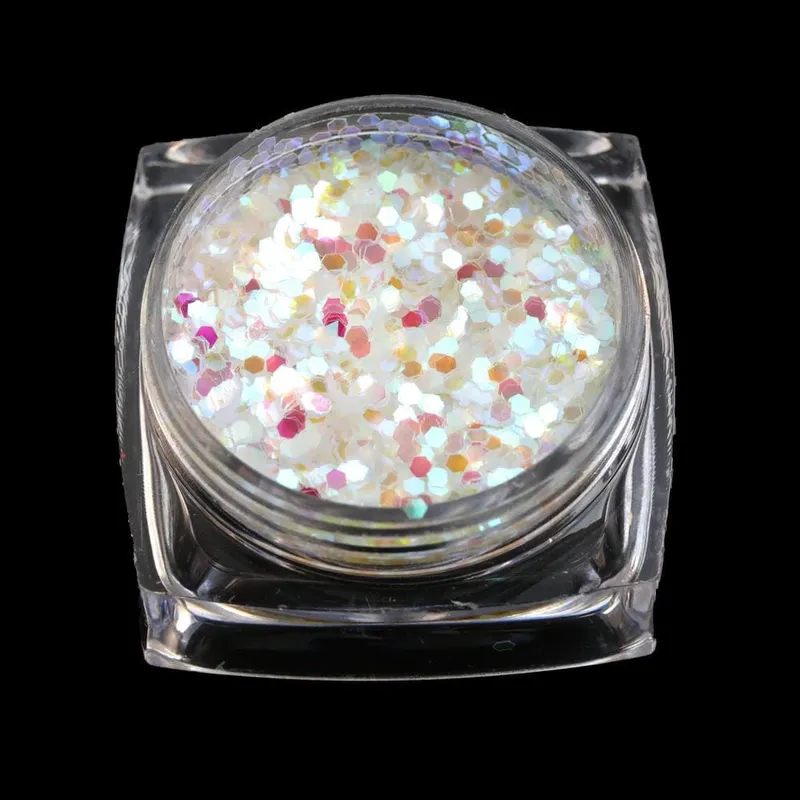
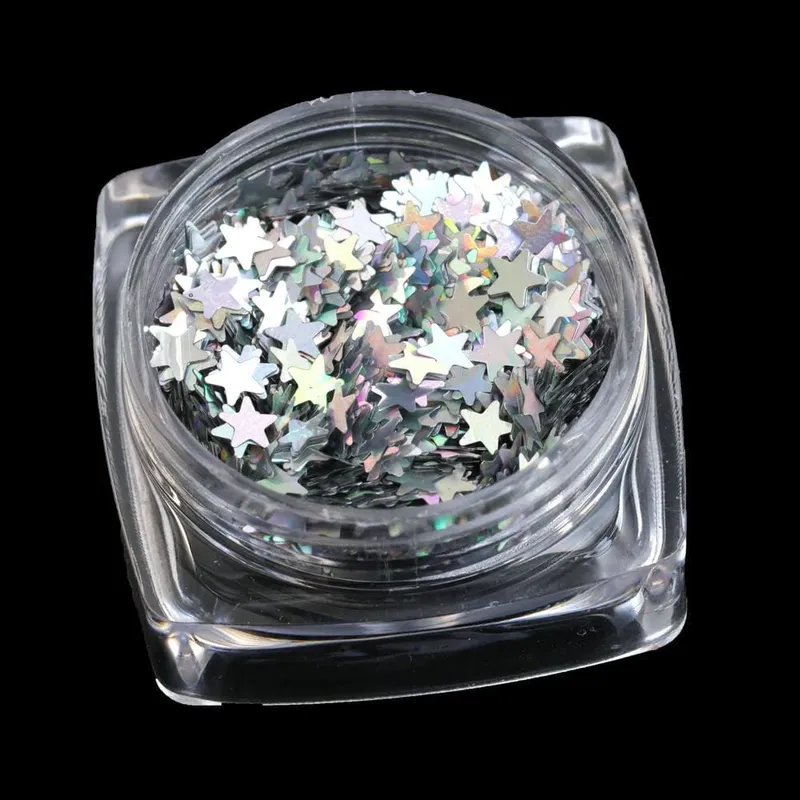
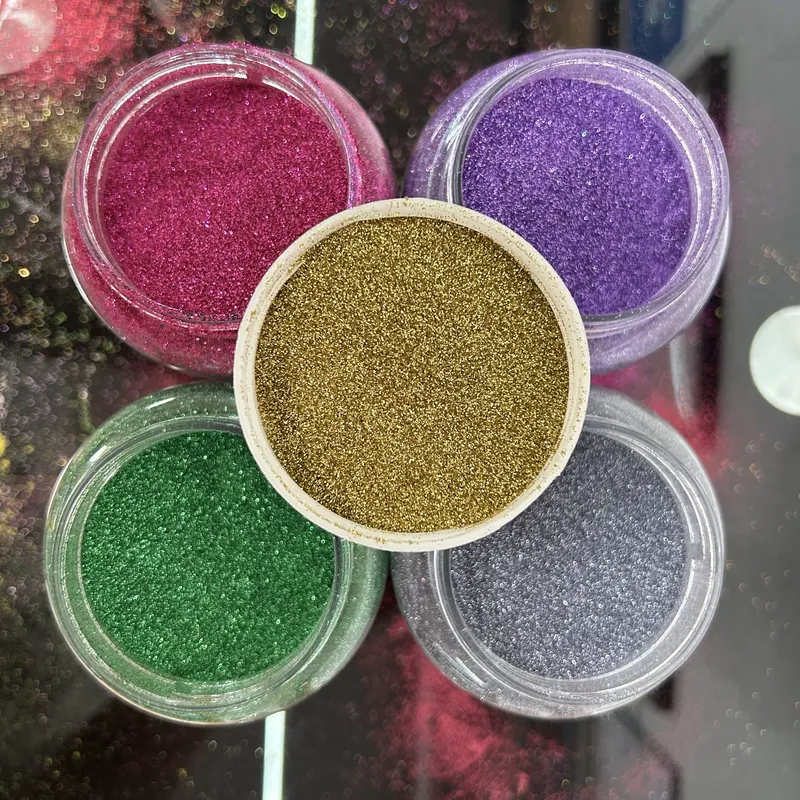
Compare these material candidates after reviewing your process and document needs. The photographs below show glitter samples for product selection.
The supplied company information lists repacking options from 3 g to 25 kg. Share the desired fill weight, container and label; the available format, quantity and commercial terms must be agreed for the order.
Does a craft glitter description mean it is suitable for children?+
No. Specify the age group, activity, final product and market. Request the evidence needed for that project and have the finished kit or item assessed by the responsible team.
How should I approve a custom blend?+
Approve a physical blend with identified colours, cuts and outlines, together with a packed reference. Agree how the production blend will be compared and retain a sample for repeat orders.
Industry requirements
Make the brief specific.
Explore what matters in your sector, which documents to request and what to agree before approving a sample.
Describe the craft activity, glue or base, intended users and destination market. Send your colour assortment or blend reference, preferred cut and shapes, pack size, closure, label requirements and estimated quantity. Identify any environmental claim or age-related requirement that needs separate evidence.