Screen the selected grade in your binder and through your application equipment. Define exposure, mixing, film build and cure conditions before treating a decorative finish as ready for production.
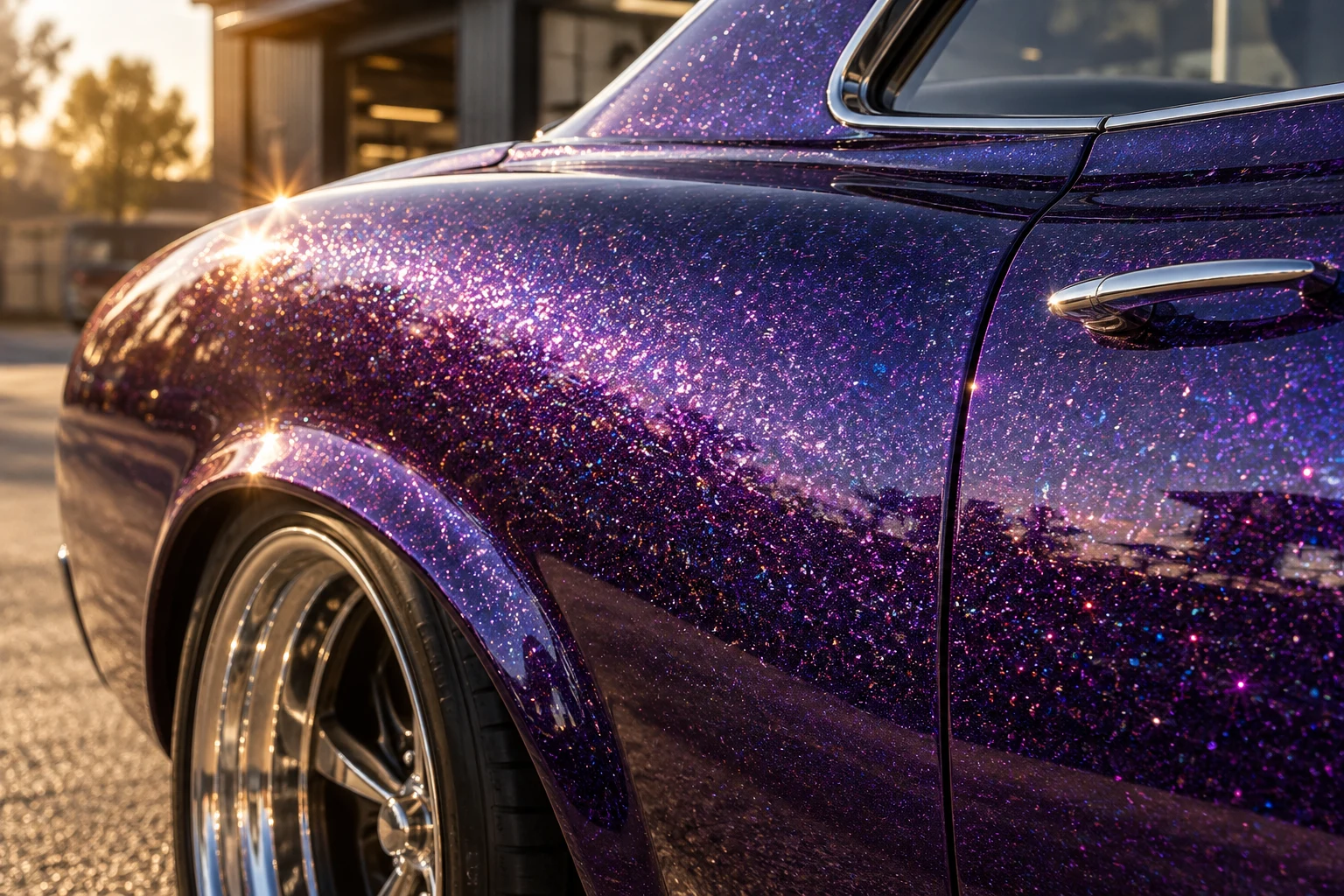
Automotive metal-flake paint — a sparkling finish beneath the clear coat.
THE PROJECT AT A GLANCE
Finished products
Decorative coated surfaces, screen prints and specialty ink finishes
Working system
The exact binder, additives, mixing sequence and application equipment
Approval reference
A cured panel with formula, process and conditioning records
WHERE THE FINISH WORKS
Define the finished product.
Automotive metal-flake finishes
Build the glitter effect on a representative coated panel using the intended basecoat, binder and clearcoat. Review sparkle and flake distribution across the curve, then agree adhesion, curing and exposure checks for the complete coating system.
Screen and specialty printing inks
Compare the proposed cut with the actual screen or delivery path. Review flow, edge definition and the finished print before choosing a size based only on the loose-material appearance.
Premixed products held before use
Include the expected time between mixing and application. Review the candidate in the stored formulation as well as the fresh mix, using conditions and acceptance criteria set by your technical team.
YOUR DEVELOPMENT CHECKLIST
Specify the process. Agree the acceptance checks.
Use these six points to prepare the sample brief. Set the test method and pass criteria for your finished product before approving a material.
Requirement
What to specify
What to verify
Binder & exposure
Binder identity, relevant water or solvents, additives, concentration, exposure time and temperature.
Screen the exact glitter code in the intended formulation. Inspect colour transfer and particle changes; do not infer resistance from PET alone.
Mixing & loading
Addition sequence, loading with units, mixing equipment, mixing time and relevant shear conditions.
Compare candidates prepared in the same way. Include a binder-only control and retain the trial preparation record.
Delivery path
Screen opening, nozzle, roller, coating gap or other passage limits, together with particle dimensions.
Run the actual equipment and assess flow, blockage, edge definition and distribution before production approval.
Film build & appearance
Substrate, backing colour, wet/final film thickness and any clear layer.
Approve the dry or cured surface at its final build and viewing conditions, including the topcoat when used.
Cure & subsequent exposure
The full cure schedule, repeated passes and any later heat, light, cleaning or other exposure relevant to the product.
Use conditions and acceptance limits agreed by the technical team. Keep the result specific to the tested construction and programme.
Premix storage
The expected holding period, storage conditions and remixing procedure before application.
Compare fresh and conditioned formulation for settling, clumping, colour transfer and recoverability. Request a separate review before substituting water-degradable plant-fiber material.
CONNECT THE SAMPLE TO ITS RECORDS
Build the material review file.
Request the following for the selected grade and project. The available documents below show their own sample identity and scope.
01Grade-specific technical data
Confirm the substrate, finish, colour code and particle dimensions, along with the available handling instructions.
02Current SDS
Use the material safety information for storage, handling and formulation planning; it is not a compatibility test result.
03Relevant test reports
Match any submitted report to the selected material, conditions and requested endpoint rather than treating a general series name as coverage.
04Formulation and pilot records
Retain the control, glitter sample, loading, mixing, storage, equipment, film build and full cure record with the approved panel.
Available documentation
Available documents for material review
Open the supplied originals and compare the tested sample with your specification. These records apply to the samples and methods identified in each document.
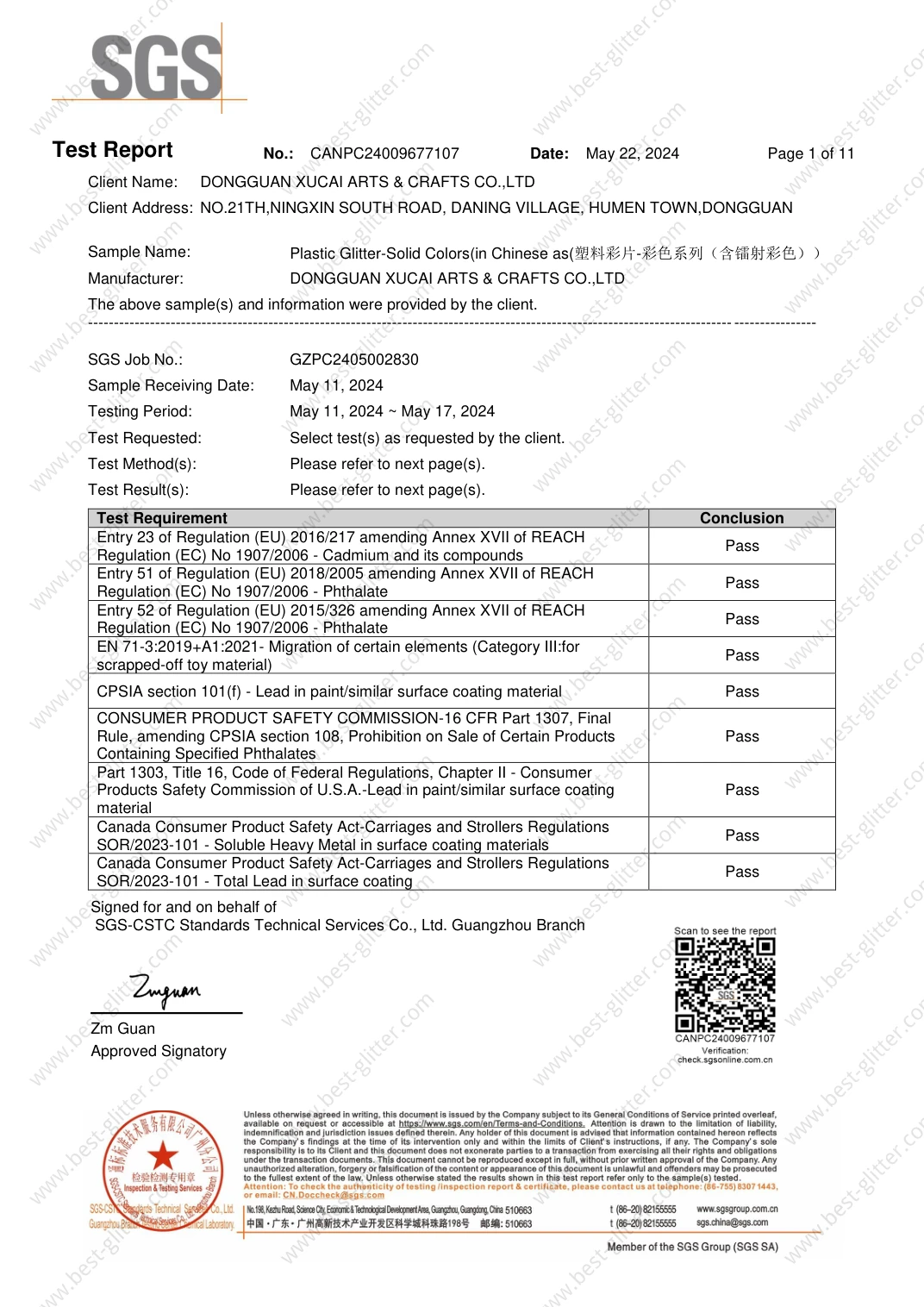
Plastic Glitter–Solid Colors, including laser colours
Scope & limitations +
Sample scope. Reference report for this colour series; confirm the current ordered grade, colour and particle size with XUCAI.
Recorded result. The listed cadmium, restricted-phthalate, lead and element-migration requirements are marked Pass. Bisphenol A and additional phthalates are reported as See Results.
Method. REACH Annex XVII: selected cadmium and phthalate requirements; EN 71-3:2019+A1:2021: migration of certain elements; CPSIA / 16 CFR: selected lead and phthalate requirements; ISO 8124-3:2020/Amd.1:2023: migration of certain elements; ASTM F963-23: selected surface-coating requirements
Applies to the submitted sample and listed tests. This is not a full REACH, toy-safety or cosmetic certification and does not cover every colour, batch or finished formulation.
Dated sample report; no expiry date is stated. Confirm the selected grade and the current requirements before ordering.
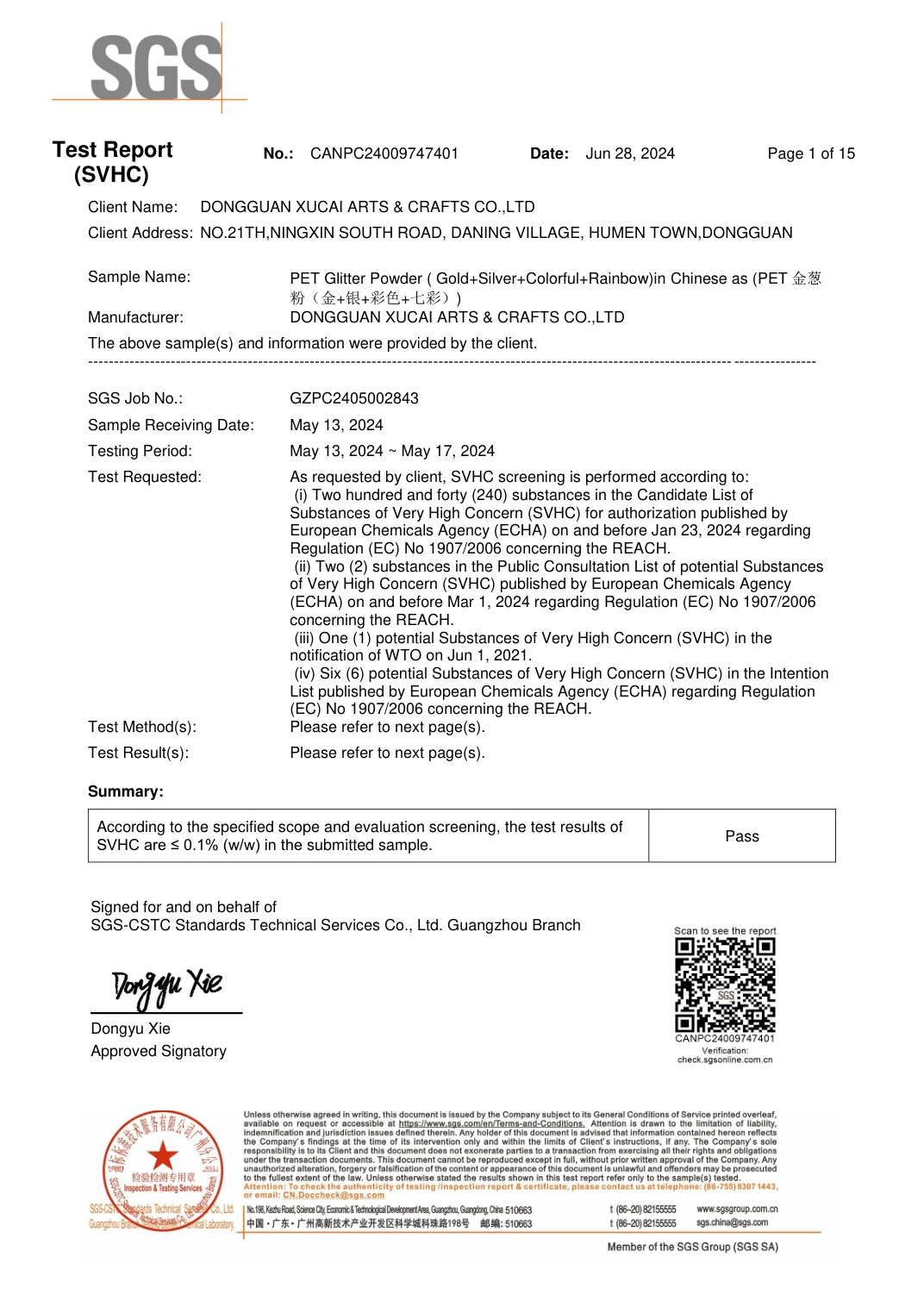
PET Glitter Powder (Gold + Silver + Colorful + Rainbow)
Scope & limitations +
Sample scope. Gold, silver, coloured and rainbow PET glitter in the submitted sample. Review the full report and request updated screening where the current market or product requires it.
Recorded result. The report records Pass, with screened SVHC at or below 0.1% by weight in the submitted sample.
Method. 240 ECHA Candidate List substances published on or before 23 January 2024; Additional consultation / intention substances expressly listed in the report
The substance list is dated and may have changed. This is not proof of compliance with the current entire REACH regulation or approval for cosmetic, food-contact or other finished-product uses.
Dated sample report; no expiry date is stated. Confirm the selected grade and the current requirements before ordering.
A test report records a result for a submitted sample. An SDS or MSDS provides safety information. Neither should be presented as a certification of every colour, series or finished product.
FROM PROCESS TO PARTICLE
A practical selection path.
01
Share the relevant formulation conditions
Identify the binder and relevant water or solvent exposure, additives, mixing method and storage conditions. Agree a suitable disclosure route if the formulation is confidential.
02
Compare candidates under controlled conditions
Use the same loading and preparation method for each candidate. Include a binder-only control and, where available, your currently accepted glitter as a reference.
03
Run the intended application and cure
Record the delivery equipment, wet and finished film thickness, and curing time and temperature. Check the finished surface rather than approving a fresh liquid mixture alone.
04
Transfer the accepted sample to a pilot run
Retain the material and panel with the trial record. Review a pilot using the production mixing and application sequence before confirming the bulk specification.
PHYSICAL MATERIAL REFERENCES
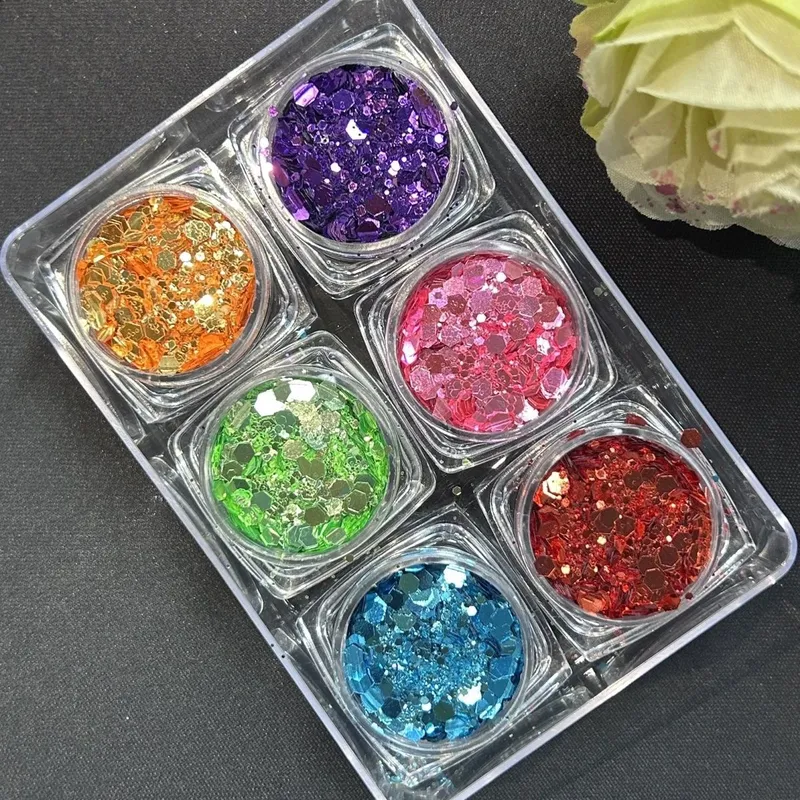
Material samples to trial.
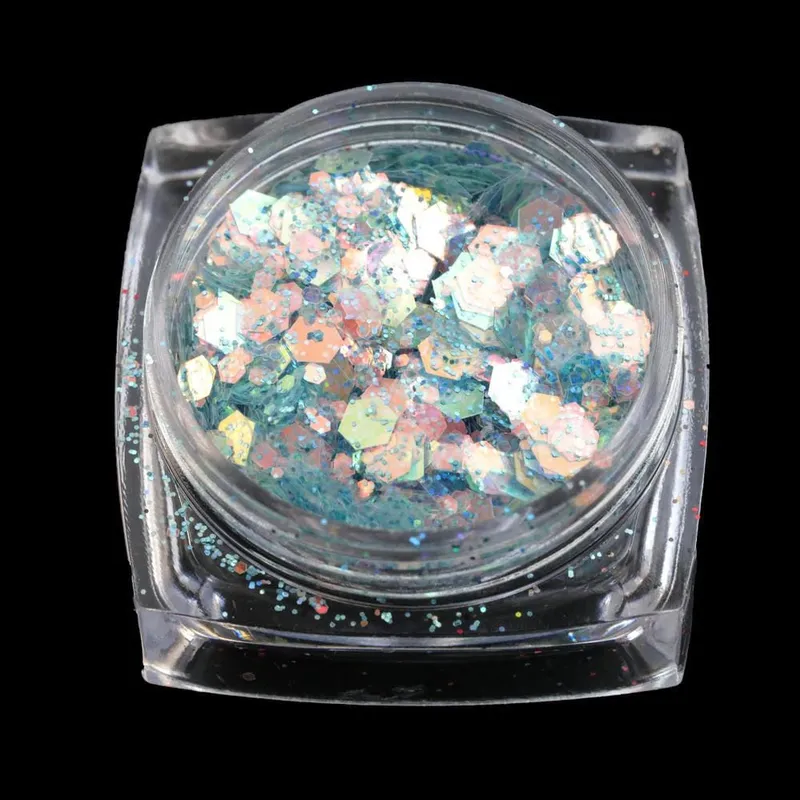
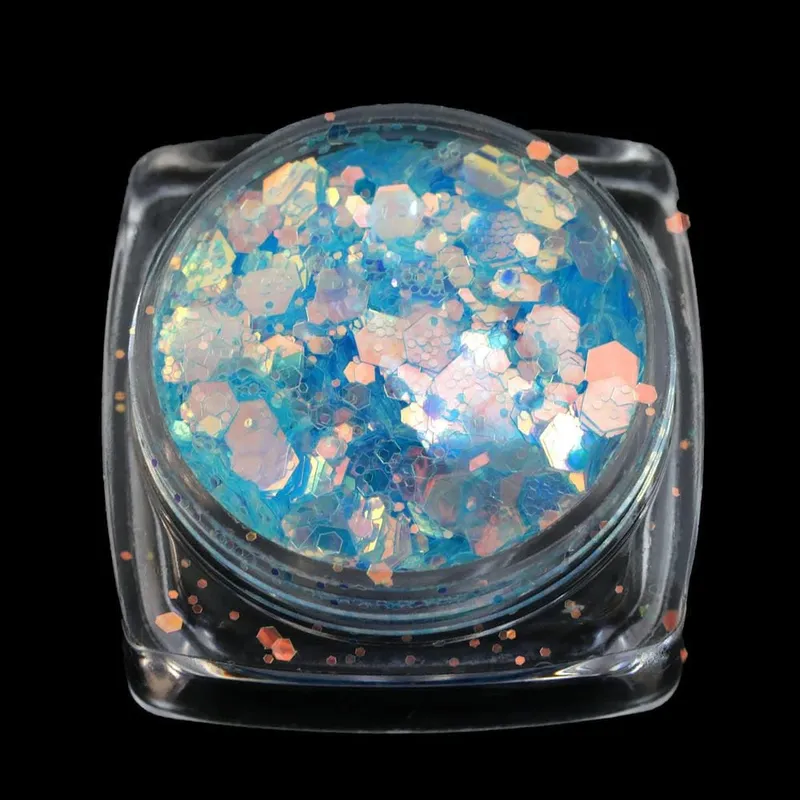
Compare these material candidates after reviewing your process and document needs. The photographs below show glitter samples for product selection.
Does PET glitter automatically resist our solvent?+
No. Ask for information on the exact grade, colour and finish, then test it in your formulation for the relevant concentration, temperature and duration. A general material name is not a test result.
Can a short heat test qualify a longer oven cycle?+
Do not extend a result beyond its documented conditions. Provide the full time and temperature profile, including repeated passes if relevant, and qualify the sample against that process.
Can I substitute the plant-fiber range into a premixed coating?+
Not on the basis of appearance. Existing supplier guidance for that water-degradable range does not recommend premixing into oil or adhesive for later printing or coating. Request a specific process review before considering a substitution.
Industry requirements
Make the brief specific.
Explore what matters in your sector, which documents to request and what to agree before approving a sample.
Send the binder system, relevant solvent or water exposure, mixing sequence, loading and storage period before use. Include the application equipment, target cut, substrate, film build, cure time and temperature, desired effect and the tests required for acceptance.